




Dowren Encyclopedia
Time of issue:2024-05-25 14:57
source:
author:
Thermoplastic polyester elastomer
Linear block copolymers
Thermoplastic polyester elastomers (TPEE), also known as polyester rubber, are a class of linear block copolymers containing PBT (polybutylene terephthalate) polyester hard segments and aliphatic polyester or polyether soft segments. TPEE combines the excellent elasticity of rubber and the easy processing of thermoplastics, with adjustable hardness and design freedom, and is a new variety of thermoplastic elastomers that has attracted much attention.
Product Name:Thermoplastic polyester elastomer alias:Polyester rubber
abbreviation:TPEE attribute:Linear block copolymers
-----------------------------------------------------------------------------------------------------------------------------------------------------------
Brief introduction
Thermoplastic polyester elastomers (TPEE) have better processing properties and longer service life than rubber; Compared with engineering plastics, it also has the characteristics of high strength, better flexibility and dynamic mechanical properties. For most applications, TPEE can be used as is, and additives can be added to meet special requirements.
------------------------------------------------------------------------------------------------------------------------------------------------------------------------------------------------------------------------------------------------------------------------------------------------------------
Elastomer properties
The characteristics of TPEE are:
1. Excellent bending fatigue resistance
2. Instantaneous high temperature performance
3. Excellent impact resistance, especially at low temperatures (-40°C)
4. Good tear resistance and abrasion resistance
5. Excellent chemical and weather resistance
6. Excellent electrical properties
7. Excellent charge tolerance
8. Adhesion to materials such as ABS, PBT and PC
9. Adhesion to paint, glue and metal
10. The diversity of processing and easy processing, good melt fluidity, stable melting state, low shrinkage and fast crystallization speed.
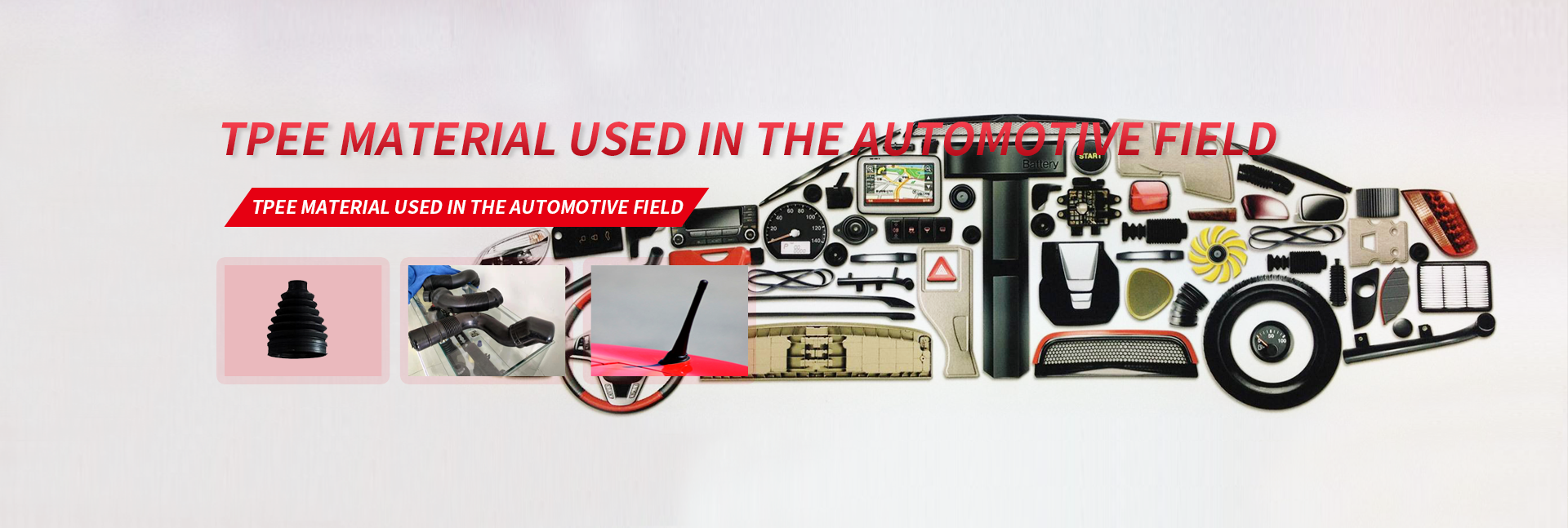
Due to its outstanding mechanical strength, excellent resilience and wide operating temperature, TPEE has been widely used in automotive parts, hydraulic hoses, cables and wires, electronic appliances, industrial products, stationery and sports supplies, biomaterials and other fields, among which it is the most widely used in the automotive industry, accounting for more than 70%.
------------------------------------------------------------------------------------------------------------------------------------------------------------------------------------------------------------------------------------------------------------------------------------------------------------
Physicochemical properties
1、Mechanical properties
By adjusting the ratio of soft and hard segments, the hardness of polyether ester elastomer can be from Shore D (32~82), and its elasticity and strength are between rubber and plastic. Compared to other thermoplastic elastomer TPEs, polyether ester elastomers have a higher modulus at low strain conditions than other thermoplastic elastomers of the same hardness. When modulus is an important design condition, polyether ester elastomers can reduce the cross-sectional area of the product and reduce the amount of material.
Polyether ester elastomers have extremely high tensile strength. Compared to polyurethane (TPU), polyether ester elastomers have a much higher compression modulus and tensile modulus, and the same part can be made from polyether ester elastomers and TPU of the same hardness, and the former can withstand greater loads. Polyether ester elastomers have a high flexural modulus above room temperature and are not as hard as TPU at low temperatures, making them suitable for cantilever beams or torque-type parts, especially for high-temperature parts. Polyether ester elastomers have good low-temperature and gentle compliance, low-temperature notched impact strength is better than other TPEs, and the abrasion resistance is comparable to that of TPU. Under low strain conditions, polyether ester elastomers have excellent fatigue resistance and low hysteresis losses, which combined with high elasticity make the material an ideal material for multiple cycle load use, gears, rubber rollers, flexible couplings, and belts.
2.Thermal performance
If antioxidants are not added, polyetherester thermoplastic elastomers will quickly degrade under many conditions, such as water mist, ozone, outdoor atmosphere, etc., reducing their viscosity and relative molecular weight, decreasing the elongation at break, and deteriorating the instantaneous elastic recovery rate. This degradation reaction of polyether ester is a free radical reaction, probably due to the attack of the carbon atom attached to the polyether oxygen atom in the polymer chain, and when the polyether ester elastomer breaks the chain, formaldehyde is generated, and the formaldehyde is oxidized to formic acid, which in turn promotes the chain breakage. To improve the oxidative degradation resistance of polyether ester elastomers, appropriate stabilization methods can be used, and the added stabilizer system should include free radical scavengers, peroxide decomposition agents and formaldehyde scavengers.
Polyether ester elastomers have excellent heat resistance, and the higher the hardness, the better the heat resistance. It has been reported in the literature that polyether ester elastomers are basically weightless when heated continuously at 110°C and 140°C for 10 hours, and only 0.05% and 0.1% when heated at 160°C and 180°C for 10 hours, respectively. The constant velocity heating curve shows that the polyether ester elastomer begins to lose weight at 250 °C, the cumulative weight loss is 5% at 300 °C, and the weight loss occurs at 400 °C, so the upper limit temperature of polyether ester elastomer is very high, the short-term use temperature is higher, and it can adapt to the baking temperature (150~160 °C) on the automobile production line, and it has little loss of mechanical properties at high and low temperatures. Polyether ester elastomers are used above 120°C, and their tensile strength is much higher than that of TPU.
In addition, polyether ester elastomers have excellent resistance to low temperatures. Polyetherester elastomers have a brittle point below -70°C, and the lower the hardness, the better the cold resistance, and most polyether ester elastomers can be used at -40°C for a long time. Due to the balanced performance of polyether ester elastomer at high and low temperatures, it has a very wide operating temperature range and can be used at -70~200°C.
3. Resistance to chemical media
Polyether ester elastomers have excellent oil resistance, and can resist most polar liquid chemical media (such as acids, alkalis, amines and glycol compounds) at room temperature, but cannot do anything against halogenated hydrocarbons (except Freon) and phenols, and their chemical resistance increases with their hardness. Polyether ester elastomer has good anti-swelling and anti-permeation properties for most organic solvents, fuels and gases, and its permeability to fuel is only 1/3~1/300 of oil-resistant rubber such as neoprene, chlorosulfonated polyethylene, nitrile rubber.
However, polyether ester elastomers have poor hot water resistance, and the addition of polycarboimide stabilizers can significantly improve their hydrolysis resistance. It has been reported that polyetherester elastomers with better water resistance and heat resistance can be obtained by introducing PEN or PCT into the PBT hard segment of the polyether ester elastomer molecular chain.
4. Weather resistance and aging resistance
Polyether ester elastomers have excellent chemical stability under many different conditions, such as water mist, ozone, outdoor atmospheric aging, etc. Like most TPEs, degradation occurs under the influence of UV light (protective additives, including carbon black and various pigments or other shielding materials. The combination of phenolic antioxidant and benzotriazole ultraviolet light shielding agent can effectively protect against ultraviolet aging).
Oxidation caused by light and heat are the two main factors of degradation and aging of polyether ester elastomers, PEG-PBT copolyester has poor heat resistance and light resistance, and thermal oxidative degradation and photoaging degradation are very serious. Heating accelerates degradation. With the decrease of molecular weight during aging, the elongation at break of the material decreases, and the instantaneous elastic recovery rate deteriorates.
In addition, polyether ester elastomers also have different degrees of hydrolysis, and polyether ester elastomers produce cross-linking reactions in water, and the amount of gel formation increases. PEG-PBT copolyester is implanted as a biomaterial scaffold to take advantage of its susceptibility to hydrolysis and degradation. PEG-PBT copolyester is degraded in water and obeys the hydrolysis mechanism, that is, the H2O molecule attacks the ester group between PEG and PBT and breaks the chain, and the degradation products are PEG and low molecular weight PBT. The degradation rate is affected by the composition, temperature, pH value, enzyme and other factors, the higher the PEG content, temperature and pH value, the faster the degradation rate, and the requirements of different uses for the degradation rate can be met by adjusting the content of the two components.
5. High resilience
The application of TPEE material to the spring can make the spring have a long service life, which can help the train start, accelerate, decelerate and stop smoothly. Unlike metal springs, they do not rust, deteriorate under natural environmental conditions, or cause elastic rupture or loss. Compared with rubber materials, it has greater reusability and retains good elasticity.
6. Processability and formability
TPEE has excellent melt stability and sufficient thermoplasticity, so it has good processability, and can be processed by various thermoplastic processing processes, such as extrusion, injection, blow molding, rotational molding and melt casting molding. At low shear rates, the melt viscosity of TPEE is not sensitive to shear rate, while at high shear rates, the melt viscosity decreases with increasing shear rates. Because TPEE melt is very sensitive to temperature, and its melt viscosity changes several times to dozens of times in the range of 10 °C, the temperature should be strictly controlled during molding.
In order to ensure that the moisture content of the resin is less than 0.1%, it needs to be blasted and dried (80-120 °C, 6-8h) before processing.
1. Extrusion
TPEE can be extruded into sheets, tubes, rods, and wire wrappers using ordinary plastic extruders. A general gradient screw can be used, with a length-diameter ratio of ≥24:1 and a compression ratio of (2.7-4):1.
2. Injection molding
Injection molding technology can be processed into products of various shapes and sizes. The reciprocating screw type injection machine is preferred because it can obtain a melt with uniform temperature, the groove depth is gradual, the recommended compression ratio is 3.0-3.5, and the screw length-diameter ratio (18-24): 1; The injection pressure is 80-120MPa, and slow to medium speed injection is used.
3. Blow molding
Blow molding requires resins with high melt viscosity and melt strength. Using the chemical chain expansion technology of polymer extrusion, special segments are blocked to the TPEE molecular chain to prepare high-viscosity TPEE that can meet the requirements of blow molding large special parts (such as engine air intake ducts).
4. Other molding processes
TPEE is also suitable for processes such as rotational molding and melt casting molding. For example, balls and small pneumatic tubeless tires are processed by the rotary molding process. Melt casting has the advantages of low processing cost and good dimensional stability of the product.
------------------------------------------------------------------------------------------------------------------------------------------------------------------------------------------------------------------------------------------------------------------------------------------------------------
Elastomer applications
TPEE is mainly used in areas where shock absorption, impact resistance, flex resistance, tightness and elasticity, oil and chemical resistance are required, and sufficient strength is required. Such as: polymer modification, auto parts, elastic telephone cords, hydraulic hoses, shoe materials, transmission belts, rotating tires, gears, flexible couplings, silencing gears, elevator slides, anti-corrosion, wear-resistant, high and low temperature resistant materials in chemical equipment pipeline valves, etc.
next page
DOWREN NEW MATERIAL (HENAN) CO.,LTD
TELL:Selina.Liu +86-0393-8993626 / +86 18137458807
ADD:150 meters north of the intersection of Zhongyuan Road and Pushang Road, Puyang City,Henan Province
EMAIL:dowren@dowren.com
WhatsApp (+86 18137458807)