



TPEE vs TPU vs TPV: Pick by Duty Cycle, Not Datasheet
Time of issue:2026-11-05 09:00
source:
author:

Choose by what the part does, not by which datasheet looks strongest. TPEE wins when a part must carry load at elevated temperature, resist oil and flex millions of cycles. TPU wins on abrasion, cut resistance and transparency. TPV wins on compression set and weatherability. If your part sits between two of these, a modified compound — not a compromise grade — is usually the cheaper route.
A question we ask every new enquiry
When a cable or hose maker asks "which is better, TPEE or TPU?", we answer with a question of our own: what does your product spend its life doing? A drag-chain cable sliding on a steel track and a CVJ boot flexing at 130 °C both need a flexible elastomer, but they fail in completely different ways. The duty cycle decides.
The comparison that matters
Property | TPEE (TPC-ET) | TPU | TPV | What it means in selection |
Service temperature, continuous | 100–150 °C | 80–120 °C | 100–135 °C | Above 130 °C, TPEE is the safer starting point |
Low-temperature flexibility | Brittle point below minus 60 °C | Good, polyol dependent | To minus 60 °C | TPEE and TPV both serve cold climates; verify the grade |
Flex fatigue at temperature | Excellent | Good | Moderate | Millions of cycles under heat favours TPEE |
Abrasion and cut resistance | Good | Best in class | Moderate | Sliding contact favours TPU |
Oil and fuel resistance | Excellent, very low permeation | Good to excellent, ester types better | Moderate | Fuel and hydraulic media favour TPEE |
Compression set | Poor vs rubber | Good | Very good | Long-term static sealing favours TPV |
UV and ozone resistance | Requires stabilisation | Requires stabilisation | Excellent, EPDM-like | Unprotected outdoor exposure favours TPV |
Processing window | Narrow, temperature-sensitive | Moderate | Wide, forgiving | TPEE demands the tightest temperature control |
Drying requirement | Mandatory | Mandatory | Minimal | TPEE and TPU need dehumidifying dryers |
Recyclability | Fully recyclable | Fully recyclable | Recyclable with little property loss | All three support regrind within limits |
Duty-cycle selection table
Application | First choice | Why | When to customise |
Robotic / drag-chain cable jacket | TPU | Abrasion and cut resistance | Add hydrolysis resistance for wet plants |
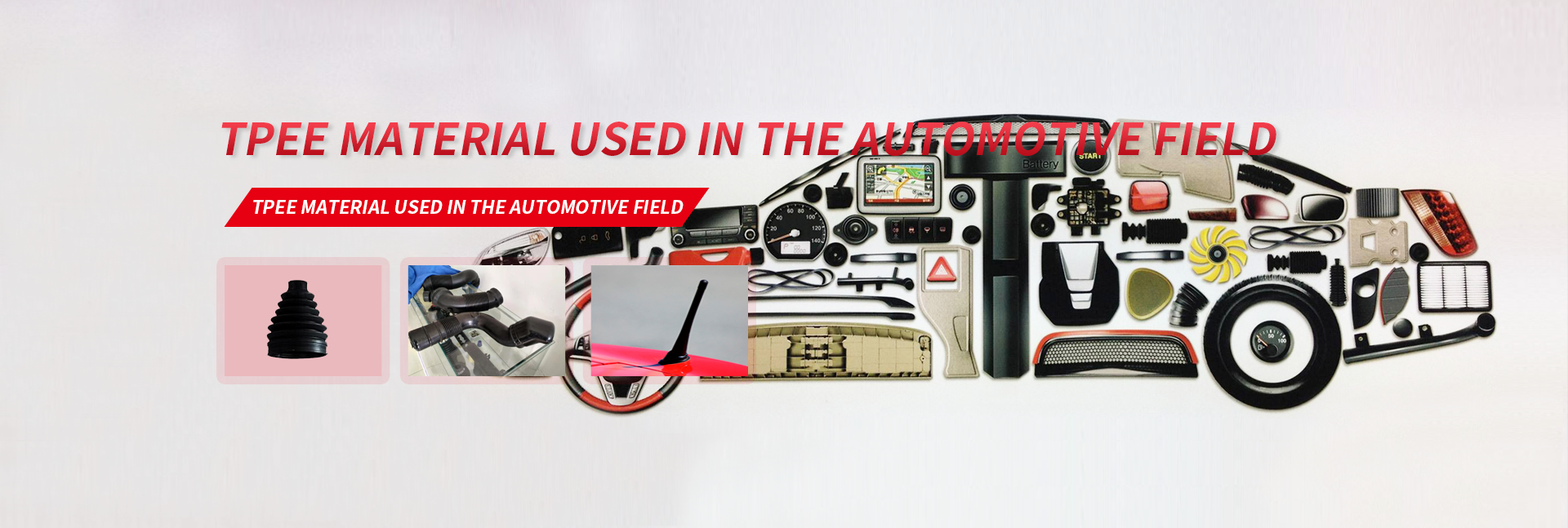
CVJ boot, constant velocity | TPEE | Fatigue life at operating temperature | Modify for low-temperature retention or grease compatibility |
Automotive corrugated tube | TPEE | Heat ageing plus fluid contact | Add halogen-free FR for wiring protection |
Hydraulic hose cover | TPU | Scuff and weather resistance | UV package for outdoor equipment |
Fuel hose lining | TPEE | Very low fuel permeation | Hydrolysis package for humid service |
Static seal, gasket | TPV | Compression set recovery | Oil-resistant grade for fluid exposure |
Outdoor weather seal | TPV | UV and ozone without additives | Colour and hardness matching |
Silent gear, coupling | TPEE | Load bearing with damping | Glass-fibre reinforced compound for stiffness |
Where standard grades stop being enough
The table above is honest: in most cases a standard grade from a recognised producer will do the job. The difficulty starts when two requirements collide.
A boot that must flex at minus 40 °C *and* resist oil. A cable that must be halogen-free flame retardant *and* survive 90 °C water immersion. A gear that must be stiff *and* damp vibration. In each case, picking one family means accepting a weakness somewhere else. This is where compounding earns its keep: the base polymer is chosen for the dominant requirement, and the package is adjusted for the second.
At DOWREN's own plant in Changzhou, we build these in-between solutions as a routine, not as a special project. A hydrolysis-stabilised TPEE with a carbodiimide package, a low-temperature toughened compound with retained oil resistance, and a halogen-free V-0 cable grade with controlled additive bloom are all produced to a customer's duty cycle rather than pulled from a catalogue.

Continuous flex in a drag chain — a duty-cycle decision
A note on price
TPEE carries a premium over TPV and most TPU. That premium buys heat resistance, modulus retention and flex fatigue. If the application does not use those properties, the premium is wasted — and we will say so. If it does, the right compound usually costs less than the failures it prevents.

Hose and sealing parts have different failure modes
Processing reality
TPEE melt viscosity is strongly temperature dependent; a small change at the die can shift viscosity several-fold. Measure melt temperature at the nozzle rather than trusting barrel setpoints. Dry TPEE and TPU before processing; TPV is the tolerant option here. Keep regrind segregated by grade and colour across all three families.
Documents and validation
For each recommendation we supply a grade-specific TDS with test methods, a lot-level COA, RoHS and REACH declarations, and, where required, flame-retardant or cable-standard certification. Samples are available from our Changzhou plant in 1 kg, 5 kg and 10 kg moisture-barrier packs for line trials.
Send us the duty cycle
Tell us the bend radius, the temperature range, the media and the expected cycle count. We will shortlist the family, propose a standard grade or a modified compound, and send samples for your line trial.
DOWREN NEW MATERIAL (HENAN) CO.,LTD
TELL:Selina.Liu +86-0393-8993626 / +86 18137458807
ADD:150 meters north of the intersection of Zhongyuan Road and Pushang Road, Puyang City,Henan Province
EMAIL:dowren@dowren.com
WhatsApp (+86 18137458807)